Showing posts with label 15mm medieval. Show all posts

Monday, February 8, 2021

How to Paint Medieval Quilted Armor

 I have always struggled with achieving depth and cleanliness when painting Byzantine quilted armor. I found a quick and easy approach that I thought I'd share. 


Basecoat the quilted portion with flat black. Or even use a heavy wash. 


Drybrush the quilted armor portions with flat white. Aim for about 95% coverage. 


Make a wash. Most illustrations of Byzantine armor is in different shades of teal. I make a spectrum of this by blending green/white at one end, blue/white at the other, and washing the two together on my palette.


Apply the wash to the drybrushed areas. I like to use the color variation mentioned above to add some interest to different figures or different parts of the armor. 


I never imagined I would use a technique involving a black basecoat and drybrushing, but do what it takes, I guess! 


Thanks for looking. 

Forged in Battle Nikeforian Byzantines Compared with Other Miniatures

This is a work in progress. I wanted to expand my Byzantine army with some medium cavalry and horse archer units, and thought I'd try the new Forged in Battle figures.  


They seem to paint up well enough. I modified some horse archers into lancers to add some variety, as I think the greatest drawback is the limited pose selection. This is understandable considering that the FIB dark ages line is extensive and was released all at once. 


I will be painting 3 5-man stands of lancers, including the commander and trumpeter. 


The cavalry figures seem to match pretty well with Khurasan's counterparts. The left figure is a Khurasan Byzantine with a headswap.

My other complaint about the FIB figures is the silly looking horse pose. These horses with the hunched-in heads and half-rearing action are pretty distinct looking, and account for about half of the horses provided. I would have preferred a more generic and natural pose. Also the figures sit much too far back on all the horses and there is a significant gap between the rider and the horse's back for most. 


I painted the commander's cape with a motif I have seen in Byzantine manuscripts. It was pretty fun. 


I will be painting these heavy horse archers next. 


Finally here's a comparison of the infantry, which are much less compatible with my existing collection than the cavalry. L-R: Khurasan, Forged in Battle, Donnington New Era, Forged in Battle, Legio heroica. They are a perfect match with Legio Heroica, but I don't think I will be purchasing any more FIB infantry in the future. 

I hope this has been helpful. 

Thursday, December 31, 2020

15mm 11th Century Seljuks

This is a project I've had brewing for several months. I actually planned the army and purchased the figures back in March. Since then I have wrapped up a few other projects with these in the background. 

These are meant to represent the Seljuk Turkish invasion of Anatolia in the late 11th century where they faced off with the the Byzantines in 1071 at Manzikert, and later against the Crusaders. These guys were also employed as mercenaries for the Byzantine side in the Balkans at different times, so they are a useful unit to have if wargaming is your thing. 

The figures are from Legio Heroica in Italy. I highly recommend supporting the company as they have great products and a friendly owner. 

I tried some new painting styles this time which I am really happy with. Instead of layering multiple shades as I have always done in the past, I basecoated the figures in white, painted with dilute colors, and then then over the cracks and crevices with thin black paint - something between a wash and blacklining. 

Another feature of this army is the large number of horses. To keep inspired as well as get the accurate horse colors, I found searching for images of the Central Asian horse sport "Buzkashi" to be helpful. One exception was the commander's horse, which I tried to paint as an Akhal Teke with tan and gold paint - you can spot him in the left edge of the image below. I am pretty happy with the result. 

Below are some more cinematic shots with the Seljuks facing crusaders and charging into battle. 


I have 3 units of light horse, made with these lightly armored Seljuks. 


Two units are based with 4 men to a base, and the 3rd unit is based individually to break up the lines for visual appeal. 


I also have 3 units of guard cavalry called Ghilman. Elite slave soldiers with a lifetime of training and fighting experience. 

These are based with 5 per stand, and again one unit based individually. 


Finally I have 3 units of foot soldiers - 2 heavy infantry made up of Arab soldiers, and one light unit of Seljuk spears and archers. I have to finish a final unit of light infantry. 


Thanks for looking! I will return to "Western" topics eventually, with Lombard and Italo-Norman units. 


Saturday, May 9, 2020

11th Century Frankish army - 15 mm


These are all Khurasan miniatures with a few conversions.
They are not intended for the more famous Norman conquest of Britain, but instead for the adventures in the Mediterranean such as the Italian and Sicilian wars, the Balkan invasions, and the 1st Crusade.

They were pleasant to paint since about 4/5 of their bodies are fully armored. I did spend some more time on the shields which were fun to paint and are really the main thing I see.


Combined with my previous two units, I now have 6 units of cavalry:


The two new heavy cavalry stands:


and two light cavalry stands with javelins and spears:


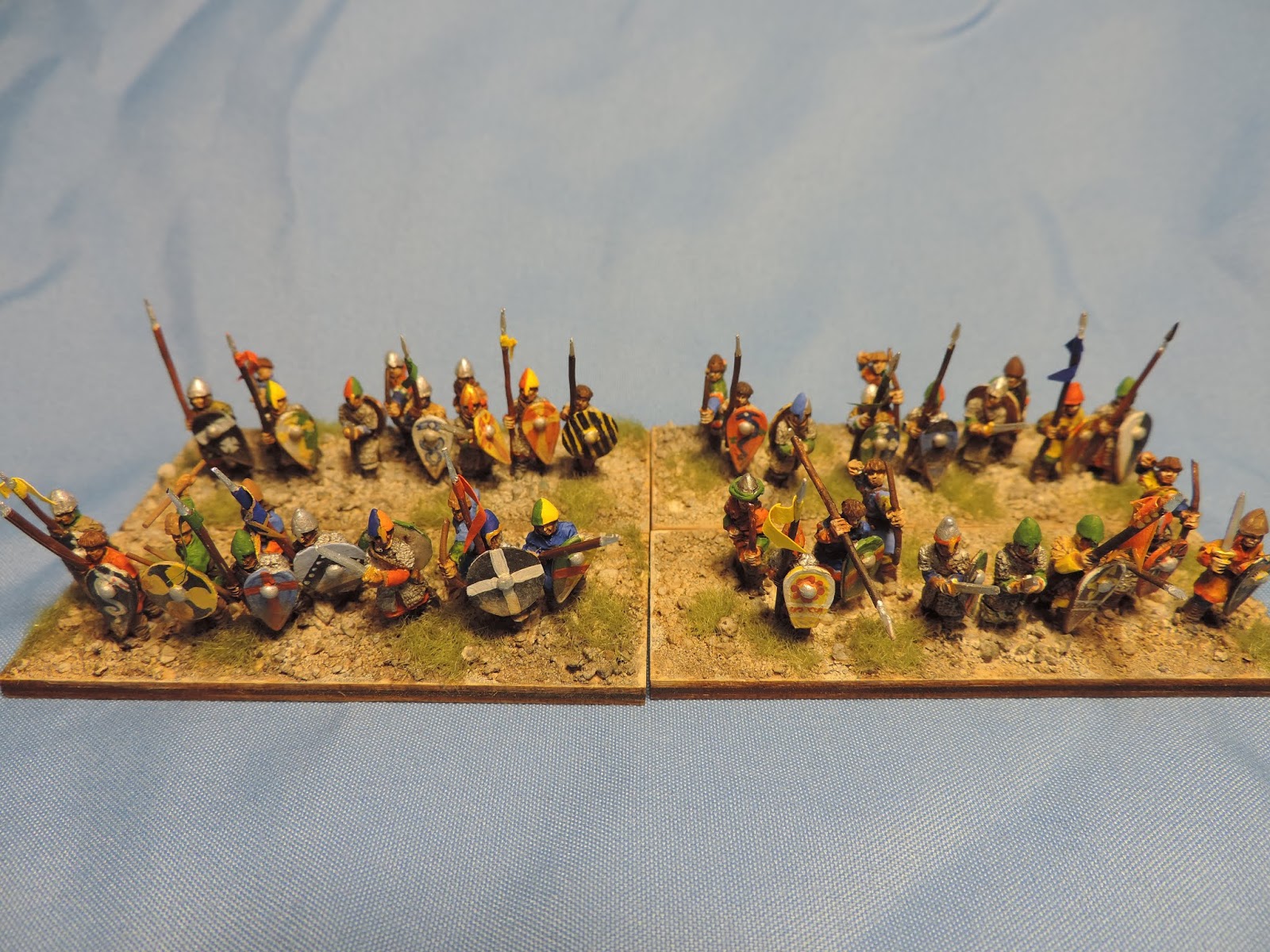
There are also 4 new infantry elements (spears, swords, and archers mixed in:


This includes 2 stands of genuine Normandy Normans:


One stand of Sicilian/Italian Franks:


And finally a stand of Eastern or German Franks (I forgot to paint the javelin tips!)


Thanks for looking. Stay tuned for some Seljuks!

Thursday, April 23, 2020

11th Century Byzantine Army - 15mm

I finished my 15mm Byzantine force. These are Khurasan and Donnington miniatures.
In this period, many Byzantine armies were dominated by mercenaries as the empire tended to have lots of money and only a few trained soldiers. Also, they had so many enemies that they would typically appease one faction with a temporary alliance (and lots of money) to fight a new campaign against another faction.
The core of the army were the Thematic divisions - standing units of foot soldiers from each imperial province. Another permanent unit were the Varangian guards who acted as the imperial bodyguards.
I have tried to reflect some of this here.
Thanks for looking.

The whole lot


Frankish Mercenaries


Pecheneg Mercenaries


Seljuk mercenaries


Byzantine nobles


Varangian guards (front) and Armenian foot (back)


3 divisions of thematic infantry 


Some actions shots